- Thread Author
- #1
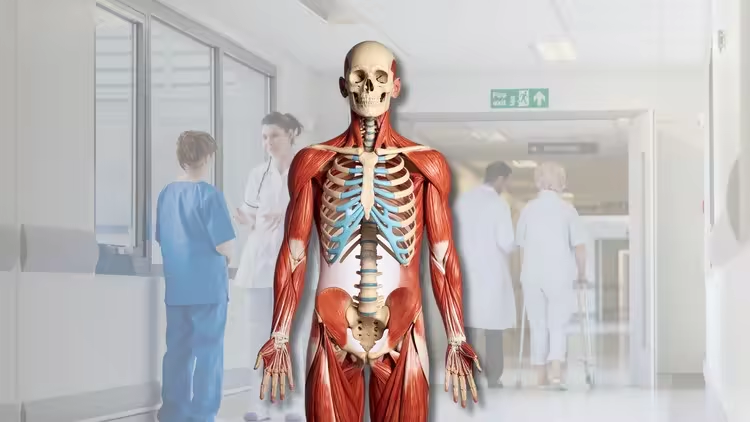
Free Download Human Anatomy & Physiology Structural Organization of Body
Published 12/2025
MP4 | Video: h264, 1920x1080 | Audio: AAC, 44.1 KHz, 2 Ch
Language: English | Duration: 1h 31m | Size: 884 MB
Human Anatomy 101: Understanding Body Structure and Systems, From Cells, Clinical Foundations to Organ Systems.
What you'll learn
Understand the scope and branches of human anatomy and how anatomy is applied in healthcare and life sciences
Use correct anatomical position, directional terms, body planes, and sections with confidence
Explain the levels of structural organization from cells to organ systems
Describe basic cell structure, cell functions, and the major types of human tissues
Identify the structure and functions of the integumentary system
Understand the organization of the skeletal system, bone types, and joint classifications
Explain muscle tissue types and the principles of muscle movement
Describe the structure and function of the central and peripheral nervous systems
Understand how neurons transmit signals and identify major brain and spinal cord regions
Explain endocrine glands and hormonal regulation
Describe heart anatomy, blood flow, and the organization of blood vessels
Understand the structure and immune role of the lymphatic system
Explain respiratory system anatomy and the process of gas exchange
Describe the structure and function of the digestive, urinary, and reproductive systems
Requirements
No prior knowledge of human anatomy is required
Ability to understand basic scientific terms (all key concepts are explained in the course)
Interest in healthcare, medical sciences, or human biology
Description
Unofficial Course ||This course provides a comprehensive and structured introduction to human anatomy, designed to help learners develop a clear and practical understanding of the structure of the human body. It begins by establishing essential anatomical concepts, including the scope and branches of anatomy, standard anatomical position, directional terminology, body planes, and levels of structural organization. These foundations ensure that students can confidently interpret anatomical descriptions, diagrams, and medical imaging perspectives used throughout healthcare and life sciences.The course then explores the microscopic building blocks of the body, focusing on cellular structure, basic cell functions, and the major tissue types. Learners will gain a solid understanding of epithelial, connective, muscle, and nervous tissues, followed by an in-depth study of the integumentary system, including the skin and its associated structures. This section connects cellular and tissue-level organization to whole-body protection, regulation, and sensation.A detailed examination of the musculoskeletal system follows, covering bone classification, skeletal organization, and joint structure. Students will learn how the axial and appendicular skeletons support and protect the body, as well as how joints and muscles work together to produce movement. The principles of muscle action are explained clearly to help learners understand posture, motion, and functional anatomy.The course continues with an in-depth overview of the nervous and endocrine systems, highlighting how the body controls and coordinates its activities. Learners will study the structure and function of neurons, nerve signal transmission, major regions of the brain, the spinal cord, and peripheral nerves. The endocrine system is presented alongside the nervous system to illustrate hormonal regulation and long-term control of physiological processes.Key transport, defense, and gas exchange systems are then covered through a detailed study of the cardiovascular, lymphatic, and respiratory systems. Students will examine heart anatomy, blood flow pathways, blood vessels, and circulation, as well as the structure and immune functions of the lymphatic system. The respiratory system is explored with a focus on airway anatomy and the mechanisms of breathing and gas exchange.Finally, the course addresses the digestive, urinary, and reproductive systems, emphasizing their roles in nutrition, waste elimination, fluid balance, and reproduction. Learners will understand the structure of the digestive tract and accessory organs, the processes of digestion and absorption, the anatomy of the kidneys and urinary pathways, and the essential features of both male and female reproductive systems.By the end of this course, students will have a strong, system-by-system understanding of human anatomy, enabling them to confidently progress into advanced studies in healthcare, medicine, nursing, allied health sciences, or biology, and to apply anatomical knowledge in academic, clinical, and real-world contexts.Thank you
Who this course is for
Beginners who want a clear and structured introduction to human anatomy
Students preparing for studies in medicine, nursing, pharmacy, or allied health sciences
Healthcare and medical science students who want to strengthen their anatomy foundation
Biology and life science students seeking a system-based understanding of the human body
Professionals in healthcare-related fields who want to refresh their anatomy knowledge
Anyone interested in learning how the human body is structured and organized
Homepage
Code:
https://www.udemy.com/course/human-anatomy-physiology-structural-organization-of-body/
Code:
[b]DDownload[/b]
https://ddownload.com/x5ntiq8w17so/uzsjb.Human.Anatomy..Physiology.Structural.Organization.of.Body.rar
RapidGator
https://rg.to/file/36577b2bee56f75a395f2c7079727d2f/uzsjb.Human.Anatomy..Physiology.Structural.Organization.of.Body.rar.html
[b]AlfaFile[/b]
https://alfafile.net/file/AFENr/uzsjb.Human.Anatomy..Physiology.Structural.Organization.of.Body.rar

FreeDL
https://frdl.io/xk7e8gx437d4/uzsjb.Human.Anatomy..Physiology.Structural.Organization.of.Body.rar.html